AREVA ( back to the Home Page )

Log in
This page allows you to manage all your areva.com electronic subscriptions.
Register
Suscribe to the AREVA dashboard give you an access to newsletters, news, and email alerts from the Dialogue section...

Recycling used fuel from reactors

Nuclear used fuel storage/interim storage pool in AREVA La Hague

AREVA's La Hague plant located in the Manche region provides the first stage in the recycling of  nuclear used fuels. This industrial operation meets a raft of energy and environmental considerations. The facility has the industrial capacity necessary for the annual processing of used fuel from 80 to 100 nuclear reactors, amounting to 1700 tons. This makes AREVA the biggest operator in the world in the processing of nuclear fuel.

Used fuel processing: a high quality service

Entering into service in 1966, the AREVA site in La Hague, the leading industrial center of its type in the world, processes nuclear used fuel for subsequent recycling - fuel which has been replaced in nuclear power plants.

Once discharged from the reactor, the used fuel contains:

  • 96% recyclable material: 95% uranium and 1% plutonium, which will be reused to produce electricity.
  • Just 4% waste (fission products and minor actinides).

Processing, the first step in recycling, is a high quality service. Throughout the process, the nuclear materials in the used fuel remain the property of AREVA's customers.

AREVA La Hague receives used fuel sent by french and foreign electricity companies.

In accordance with French law:

  • The waste taken from used fuel from foreign electricity companies are returned to their country of origin after processing. 
  • French waste is temporarily stored onsite pending a permanent storage facility.

The recycling of recovered materials (uranium and plutonium) enables:

  • Savings of up to 25% in natural uranium needs,
  • Reductions in the volume and toxicity of end waste, to a large extent, through processing and conditioning designed to suit each type of waste.

The major steps in processing

The major steps in processing:

  • Receiving and storing fuel prior to processing.
  • Separating the various components of used fuels and radioactive materials.
  • Recovering energy materials (uranium and plutonium) with a view to recycling them in the form of new fuels for the production of electricity.
  • Waste conditioning. Integrated in glass for safe, stable conditioning over the very long term, or compacted to reduce their volume.

Display the detail

The major steps in processing

Display the detail

Shipping, reception and interim storage

Shipping, reception and interim storage

Cask of used fuel

Shipping safety depends on the container of the material to be transported for the protection of the environment.

Assemblies are therefore packed in "flasks", 110 ton steel enclosures that can contain 10 tons of nuclear materials.

The used fuel is shipped in &uot;flasks&uot; by trucks, trains, or boats that have been specially designed for this purpose. They are transported to the Valognes terminal, before arriving at AREVA's plant in La Hague.

Upon its arrival on site, the used fuel is discharged from its container. Two methods are used for this: dry or in water.

As is the golden for any action on used fuel, all operations are carried out remotely and in complete safety, by remote control or by powered robot, at all times when the used fuel is present at the AREVA La Hague site.

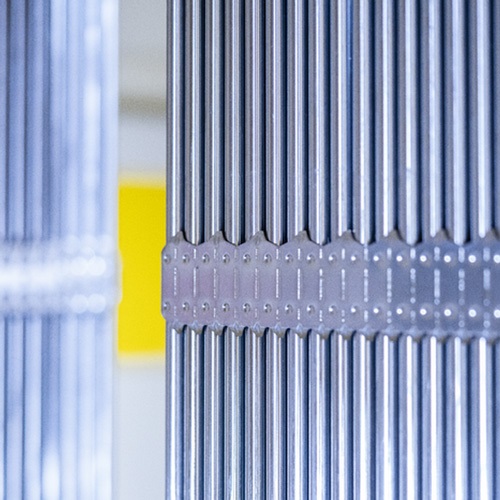
The fuel elements are then placed in frames and transferred to interconnected interim storage pools. Submerged nine meters under water, they stay in the interim storage pool for three to five years in order to enable their radioactivity to fall. Four meters of water separate these elements from the surface, in order to guarantee protection.

Interim storage pool, LA HAGUE FACILITY.  CHERBOURG. FRANCE

Interim storage pool, LA HAGUE FACILITY, CHERBOURG. FRANCE

Display the detail

Separating the various components of used fuels

Separation and purification of uranium and plutonium

Sections of fuel after shearing

  • Shearing and checking. Once its pool cooling period has finished, the fuel element is:
    • Transferred to workshops R1 or T1,
    • Checked to verify its identification and burn-up fraction,
    • Inserted in the shears to obtain 35mm sections which fall into a tank known as a dissolver, filled with nitric acid,
    • The acid dissolves the nuclear material while the pieces of the metallic structure (sheath) are removed using a bucket wheel and sent to a conditioning unit.

  • Separation. The nitric acid solution containing the nuclear material is then transferred to a chemical separation facility:

    - In a set of mixer settlers and pulsed columns, a solvent (tributyl phosphate) brings out the heavy elements (uranium and plutonium) without extracting the fission products.

    - The recyclable products are therefore separated from the waste.

Display the detail

Recovering energy materials with a view to recycling them

Column extraction of uranium

Secondly, the same principle is used to separate uranium and plutonium.

  • Uranium is:

- Purified by liquid-liquid separation in mixer settler sets over two successive cycles (extraction and reextraction),

- The uranium solutions are then concentrated by evaporation in the form of liquid called uranyl nitrate,

- The uranyl nitrate is stored, checked, packed, and then transported to plants for recycling or storage in solid form.

Getting container boxes of plutonium oxide

  • Plutonium is:

- Converted into a powder known as plutonium oxide through calcination in a furnace.

- Packed in stainless steel set boxes (around 3kg each) grouped in 5 in a plasma arc welded case.

- Each case is placed in a container and checked to be water and air tight, with no contamination prior to storage.

- The containers are sent to MOX fuel fabrication plants.

Display the detail

Waste conditioning

Waste conditioning

glass casting

Once the recyclable materials have been separated, the end waste is processed:

  • The most radioactive waste, fission products, is stabilized by vitrification,
  • The metallic structures of the fuel are compacted,
  • These two types of waste are packed in containers,
  • All gaseous or liquid effluents generated during operations are treated and rigorously checked prior to their discharge into the atmosphere.

Vitrification

  • Liquid waste is directed towards a calcinator - made up of a rotating tube heated at around 800°C - within which it flows using gravity and dries to form a calcinate.
  • Once it leaves the calcinator, glass frit is introduced. Calcinate and glass frit (82% glass for 18% waste) is mixed together and then falls into a melting furnace heated by induction to over 1100 °C to form a uniform glass locking in the radioactivity.
  • In 2010, the plant acquired a "cold" crucible, in which the glass is heated by direct induction. The glass in fusion is thus isolated from the walls of the crucible by a layer of solid glass, which protects the crucible and prevents its corrosion. Temperatures above 1200 °C can be attained by means of the cold crucible technology, widening the range of radioactive waste that can be vitrified and increasing the pace of production.
  • The glass obtained through this process is poured into a stainless steel refractory container. A cover is then welded onto the container after cooling.
  • Standard containers for vitrified waste (CSD-V) are decontaminated by high-pressure water jets and by shot peening.
  • The containers are then put into storage after contamination smear tests.

Thanks to recycling and vitrification, the volume of highly radioactive waste is reduced fivefold.

The structural waste, hulls and end pieces of used fuel and the technological waste not entering surface storage are sent to the Hulls Compaction Facility (HCF). This facility enables an average fivefold reduction in the volume of waste that it processes, and also optimizes the interim storage of this waste and the subsequent handling, transportation, and permanent storage.

The Universal Containers for Compacted Waste (CSD-C) developed by AREVA have the same geometrical measurements as the Universal Containers for Vitrified Waste (CSD-V): this is the design for "universal containers".

Press for compacting scrap

The structural waste, hulls and end pieces of used fuel and the technological waste not entering surface storage are sent to the Hulls Compaction Facility (HCF). This facility enables an average fivefold reduction in the volume of waste that it processes, and also optimizes the interim storage of this waste and the subsequent handling, transportation, and permanent storage.

The Universal Containers for Compacted Waste (CSD-C) developed by AREVA have the same geometrical measurements as the Universal Containers for Vitrified Waste (CSD-V): this is the design for "universal containers".