Nuclear waste management at AREVA La Hague

AREVA's plant in La Hague recycling used nuclear fuels. Since its inception in 1966, it has reprocessed more than 25,000 tons of used nuclear fuel.
Introduction
AREVA's plant in La Hague performs the recycling of used nuclear fuels. Since its operational launch in 1966, the site has reprocessed more than 25,000 tons of spent nuclear fuel.
Only a small percentage of the nuclear materials resulting from the AREVA La Hague recycling operations are waste. These include fission products, which are literally the ashes of the fission process in the reactor, and hulls and end-fittings, which are metal components that make up the fuel assembly for loading into the reactor.
In addition, low-level waste is generated during recycling (technological waste): tools, piping, etc.
AREVA has developed and instituted a voluntary program to minimize and manage these different types of waste as effectively as possible. This program is based on a fundamental principle: for every type of waste there is an optimum type of conditioning. The type of conditioning is based on the radioactive, physical and chemical properties of each waste type.
A waste management system composed of a number of specialized technologies was set up for the AREVA La Hague site. These technologies are backed by many years of research and development conducted in France, particularly by the Atomic Energy Commission.
The waste management policy implemented by AREVA La Hague has a particular objective: to pack the majority of the waste derived from processing used fuel in a single container. This is the Universal Container, or the Universal Waste Container, used to hold either vitrified or compacted waste.
Management and treatment of technological waste
The pipes, valves, tools, cables or even plastic films constitute the technological wastes associated with running treatment installations. For the most part they have only low radioactivity, but are nonetheless considered nuclear. This is why they must be packed appropriately.
Technological waste is waste linked to running the treatment installations themselves (pipes, valves, tools, cables, plastic films, etc.). The vast majority of this waste has very little radioactivity. These items are nonetheless considered nuclear waste subject to special regulations and must be packed in an appropriate manner.
The policy for the drastic limitation of their volume (optimization of maintenance operations, source sorting, etc.) implemented by AREVA has already succeeded in considerably reducing these volumes. The option to compact using packaging in standard containers identical to the hull and end-piece containers, and to concrete of the lowest level radioactivity, makes it possible to guarantee optimum packaging.
The levels of performance attained today by the main treatment process have made it possible to considerably reduce volume and activity of the liquid wastes to treat. As such, AREVA has implemented since 1995, a new management of liquid wastes which has made it possible to increase their recycling considerably within the process while sending materials with residual activity to vitrification plants to be incorporated into standard containers of vitrified residues (CSDV).
The liquid wastes station at La Hague.
What are the advantages of treatment for nuclear waste management?
Once the used fuels are discharged from the nuclear reactors, they may be managed in a closed cycle or an open cycle. Currently, only the closed cycle has reached the industrial stage, mainly because of its dynamic and ecological advantages.
The closed cycle consists of treating the used fuel by recovering the reusable materials uranium and plutonium (around 96% of the material) to recycle them into new fuels and then appropriately package the final wastes in order to permanently store.
The open cycle, on the other hand, concerns used fuel waste products that are temporarily stored in wait for solutions to enable permanent storage.
The solution most fitting the era of sustainable development is the closed cycle. The treatment of used fuels as practiced in AREVA La Hague makes it possible to:
- Re-use the recyclable energetic materials uranium and plutonium.
- Offer secure packaging for each type of final waste.
- Reduce by a factor of at least 5 the quantity of final wastes destined for final storage.
- Reduce by a factor of 10 the toxicity of the wastes by eliminating the plutonium that it contains in the beginning.
The hulls and end-pieces used in storage are then contionned.
What happens to waste after treatment?
The final wastes stemming from industrial operations carried out on the AREVA La Hague site remain the property of the electric utility companies. When these are located overseas, the wastes must be sent back to their country of origin. These returns began in 1995 with a first transport of vitrified residue to Japan.
The final wastes stemming from industrial operations carried out on the AREVA La Hague site remain the property of the electric utility companies having submitted their used fuel to AREVA for treatment.
The treatment contracts signed since 1977-78 with Japanese, German, Belgian, Swiss, and Dutch electric companies stipulate that these wastes, after being suitably packaged for their transport and interim storage are returned to their countries of origin.
Return operations began in 1995 with a first transport of vitrified residue to Japan. the returns have already been made to Japan, to Germany, to Belgium, to Switzerland and to the Netherlands. The next operations are currently in preparation.
In this facility at La Hague, AREVA treat the liquid releases.
Management and treatment of non-reusable parts of used fuel
The 3-5% of fuel no longer possessing any energetic potential is considered final waste. These wastes are integrated into a glass matrix where they will be indefinitely encapsulated. The hulls and end-fittings are separated from the other elements. Once used, they are compacted and then stored.
Vitreous residue
The used fuels treated in the AREVA La Hague plant contain between 95 to 97% recyclable materials. The 3-5% of remainder no longer possesses any energetic potential and are thus considered final wastes: these are essentially fission products. These radioactive elements are securely packed in a minimal volume for the purpose of permanent storage.
These wastes are vitrified, in other words integrated into a homogeneous glass matrix that is stable and unalterable over time. Their confinement is therefore permanently ensured in compliance with environmental protection requirements.
The block of glass is placed in a special container: the standard waste containers for vitrified waste.
At AREVA's La Hague site, this operation is carried out in workshops R7 and T7. The glasses created in the two workshops are identical and based on specifications approved by the safety authorities of the various countries concerned: France, Japan, Germany, Belgium, Switzerland, and the Netherlands.
R7 has been in operation since 1989. T7 was launched in 1992. The nominal capacity of each workshop is on the order of 500 containers a year. By the end of 2005, more than 12,000 containers had been produced in these two workshops.
The hulls and end pieces
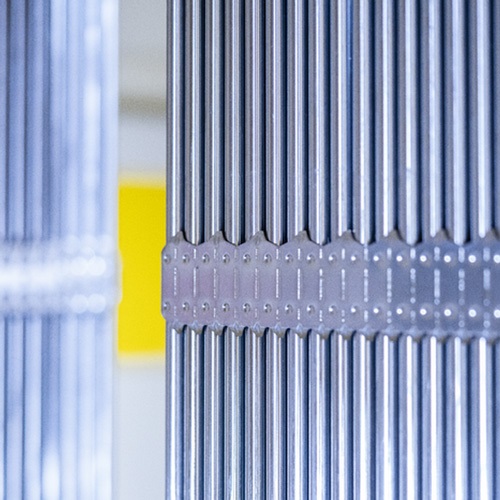
The hulls and end pieces are the metallic elements that form the structure of the used fuel assemblies. They are separated from recyclable nuclear materials (uranium, plutonium) and fission products at the beginning of the treatment process, during operations of shearing-dissolution.
In order to significantly reduce the volume of this type of waste after packaging, AREVA opened a Hulls Compaction Facility (HCF) in 2002. This facility compacts the hulls and end-pieces in the form of flat cakes that are then inserted into standard compacted waste containers.
This standardization (CSDC,CSDV) facilitates operations in handling, transport, interim storage, followed by permanent storage of these wastes. Since inception, ACC has produced more than 3,000 containers.
Technological wastes are compacted in these containers to be transported and then permanently stored.

Field Report: Discover pragmatic examples of customer benefits
12th shipment of vitrified nuclear waste from France to Germany (in french)
24 hours in La Hague
Compacting structural and technological waste processing active liquid effluents
Environmental protection in La Hague (France)
Recycling and new reactors: AREVA advantages
Health physics, Studies and Measurements - leaflet
Process management product line - leaflet
Eleventh shipment of vitrified nuclear waste from France to Germany (in french)
"Environmental report MELOX 2008" [FR]